CollectLite — Project Description and System Design
CollectLite is a full-stack human-data collection and model-evaluation platform for turning raw RAG examples into labeled, reviewable, exportable datasets. It is designed as a lower-scale reconstruction of the system class used by human-data and model-evaluation teams: project owners upload examples, generate labeling tasks, optionally ask a model for suggestions, route work to annotators, compute consensus, resolve disagreement, monitor quality, and export training/evaluation-ready data.
The implementation is intentionally scoped around one strong MVP workflow: RAG relevance labeling. A dataset row contains a user query and a candidate retrieved document. Annotators label the document as relevant, partially_relevant, or not_relevant. The system can generate model suggestions with Cohere Rerank when an API key is configured, or fall back to a local lexical-overlap scorer for demo/dev environments.
This document is tailored toward system design: what each component does, why it exists, how data moves through the system, which invariants protect correctness, and where the current implementation is complete versus intentionally left as future work.
Positioning note: CollectLite should be described as a public-evidence-inspired personal project for human-data tooling and model evaluation. It should not be described as a replica of Cohere's private internal Collect architecture.
1. System at a Glance
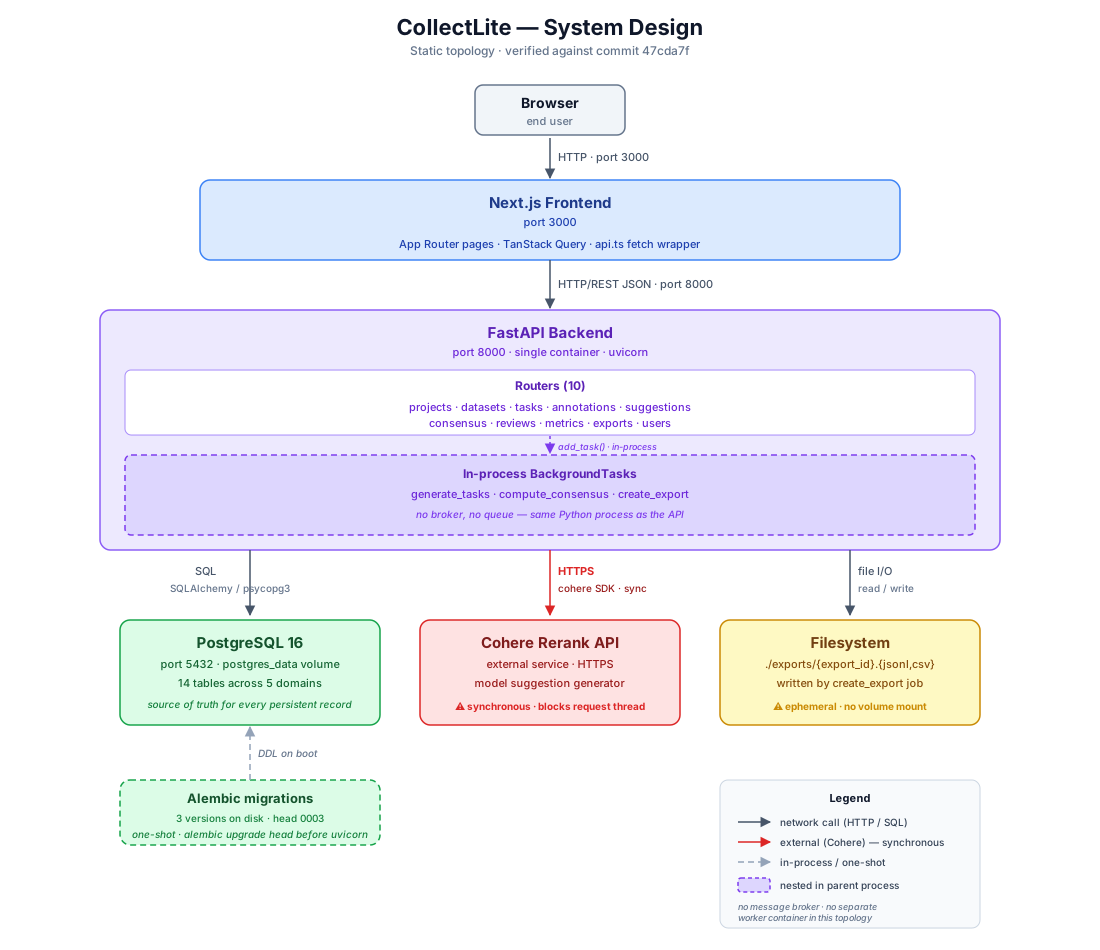
Primary goal
CollectLite solves the operational problem of creating trustworthy human labels for model evaluation. It gives a project owner a controlled lifecycle:
- Create a project.
- Upload CSV or JSONL examples.
- Normalize and deduplicate source rows.
- Generate annotation tasks from source examples.
- Optionally create model-in-the-loop suggestions.
- Let annotators submit labels with confidence metadata.
- Compute consensus once enough annotations exist.
- Route low-agreement or model-disagreement tasks to review.
- Resolve final labels.
- Export JSONL or CSV records for downstream evaluation/training.
Current implementation shape
The repository is a practical full-stack app, not just a design document. It includes:
| Layer | Implementation |
|---|---|
| Frontend | Next.js App Router, TypeScript, React, TanStack Query, Tailwind-style UI components, project/task/review/metrics/export screens |
| Backend | FastAPI app with routers for projects, datasets, tasks, annotations, suggestions, consensus, reviews, metrics, exports, and users |
| Persistence | PostgreSQL via SQLAlchemy ORM models and Alembic migrations |
| Background execution | FastAPI BackgroundTasks in the API process |
| Model-in-loop | Cohere Rerank when COHERE_API_KEY is configured; local Jaccard lexical-overlap fallback otherwise |
| Exports | JSONL and CSV files written to a local exports directory |
| Local infra | Docker Compose with frontend, backend, PostgreSQL 16, and Redis 7 |
What the architecture emphasizes
CollectLite is designed around four engineering ideas:
- Lifecycle state — task status is the central invariant:
created → suggested → assigned → submitted → needs_review → resolved → exported. - Human data provenance — raw examples, annotations, model suggestions, consensus rows, review decisions, and exports are stored as separate records rather than overwritten into one flat table.
- Model assistance without treating the model as ground truth — model suggestions are stored as metadata and compared against human consensus.
- Export correctness — only resolved tasks are included in export output, and exported tasks are moved to an
exportedstate.
2. Repository-Level Architecture
The repository is organized as a conventional full-stack monorepo:
collect-lite/
  README.md
  system-design.md
  evidence-and-design-rationale.md
  docker-compose.yml
  .env.example
  backend/
    app/
      main.py
      config.py
      db.py
      models/
      routers/
      schemas/
      services/
      workers/
    alembic/
    tests/
    pyproject.toml
  frontend/
    src/
      app/
      components/
      lib/
    package.json
  data/
    sample datasets
  docs/
    architecture/API/demo supporting docs
Architectural style
CollectLite uses a frontend + API + relational database architecture:
Browser
  ↓ HTTP
Next.js frontend
  ↓ REST/JSON
FastAPI backend
  ↓ SQLAlchemy / psycopg
PostgreSQL

FastAPI backend
  ↘ in-process BackgroundTasks
    ↘ task generation / consensus / export jobs

FastAPI backend
  ↘ optional HTTPS call
    ↘ Cohere Rerank API

FastAPI backend
  ↘ local file I/O
    ↘ exports/{export_id}.jsonl or exports/{export_id}.csv
This is a good MVP shape because it keeps the operational model simple while still preserving production-minded boundaries: typed API contracts, ORM models, background task boundaries, migrations, and explicit workflow states.
3. Component Inventory
3.1 Browser / End User
The browser is the entry point for three user behaviors:
| User behavior | UI surface | Purpose |
|---|---|---|
| Project owner workflow | Dashboard, project detail, datasets, tasks, metrics, exports | Configure and monitor data labeling work |
| Annotator workflow | Task workbench | Complete labels and optionally use model suggestions |
| Reviewer workflow | Review queue | Adjudicate disagreement and set final labels |
The frontend does not directly connect to the database or Cohere. It speaks to the backend through the api.ts fetch wrapper, using NEXT_PUBLIC_API_URL or http://localhost:8000 by default.
3.2 Next.js Frontend
The frontend owns application state presentation, navigation, form interactions, polling, and user workflow orchestration. TanStack Query is used to fetch and cache backend data.
Key frontend screens:
| Screen | Path | Purpose |
|---|---|---|
| Dashboard | / |
Lists projects and shows high-level active/draft counts |
| New project | /projects/new |
Creates a project |
| Project overview | /projects/[projectId] |
Shows project metadata and navigation to datasets/tasks/review/metrics/exports |
| Datasets | /projects/[projectId]/datasets |
Uploads CSV/JSONL and lists uploaded datasets |
| Tasks | /projects/[projectId]/tasks |
Lists tasks, selects dataset/template, queues task generation |
| Task workbench | /tasks/[taskId] |
Shows one task, model suggestion panel, annotator selector, annotation form, edit mode, skip/next navigation |
| Review queue | /projects/[projectId]/review |
Shows tasks needing review and submits reviewer decisions |
| Metrics | /projects/[projectId]/metrics |
Shows workflow funnel, agreement metrics, and label distribution |
| Exports | /projects/[projectId]/exports |
Queues JSONL/CSV exports, polls status, downloads completed files |
Frontend design purpose
The UI separates project-owner, annotator, and reviewer mental models:
- Project owners need operational visibility: datasets, generated tasks, queue counts, export readiness.
- Annotators need a narrow, fast workbench: query, candidate document, label controls, confidence, suggestion context.
- Reviewers need evidence for adjudication: all annotations, model suggestion, consensus result, source metadata.
Frontend implementation notes
- The dashboard fetches
/api/projectsand computes project status counts client-side. - Project detail fetches project metadata and metrics, then links to the five major project sections.
- The tasks page fetches tasks, datasets, and templates. It can queue task generation after a dataset and template are selected.
- The bulk “Run Model Suggestions” button is currently disabled in the UI; per-task suggestion generation is available from the task workbench.
- The task workbench supports both create and edit modes. If the selected annotator has already submitted an annotation, the UI switches into edit mode unless the task is locked.
- Tasks are locked for annotation edits when they are in
needs_review,resolved, orexported. - The exports page polls while export records are non-terminal, then exposes a download link for completed exports.
3.3 FastAPI Backend
The backend is the system of record for lifecycle transitions and workflow correctness. It exposes REST endpoints and composes routers in main.py:
projects
 datasets
 tasks
 annotations
 suggestions
 consensus
 reviews
 metrics
 exports
 users
The FastAPI app also adds:
- CORS middleware configured from environment settings.
- A
/healthendpoint. - Request latency measurement through an
X-Response-Time-Msresponse header.
Backend responsibilities:
| Responsibility | Backend owner |
|---|---|
| Project lifecycle | routers/projects.py, models/project.py |
| Upload parsing/deduplication | routers/datasets.py, services/ingestion.py |
| Task creation | routers/tasks.py, services/task_generation.py, workers/jobs.py |
| Assignment and annotation | routers/annotations.py, services/assignment.py |
| Model suggestions | routers/tasks.py, routers/suggestions.py, services/model_suggestions.py, services/cohere_service.py |
| Consensus | services/consensus.py, workers/jobs.py |
| Review decisions | routers/reviews.py, services/review.py |
| Metrics | routers/metrics.py, services/metrics.py |
| Export jobs | routers/exports.py, services/export.py, workers/jobs.py |
| Demo annotators | routers/users.py, services/users.py |
| Audit events | services/audit.py, models/audit.py |
3.4 PostgreSQL Database
PostgreSQL is the source of truth for every persistent workflow entity.
The data model is split into domain groups:
| Domain | Tables | Purpose |
|---|---|---|
| Identity / role | users |
Stores demo/current users and roles |
| Project setup | projects, datasets, source_examples, task_templates |
Defines work and preserves uploaded raw examples |
| Task execution | tasks, assignments, annotations |
Tracks work queue and human labeling submissions |
| Model assistance | model_suggestions |
Stores generated suggestions and confidence/provenance |
| Quality control | consensus_results, review_decisions, gold_labels |
Tracks resolved labels, reviewer overrides, gold labels |
| Export / audit | exports, audit_events |
Tracks output generation and important state mutations |
The schema uses JSONB for flexible payloads such as uploaded example fields, label schemas, annotation labels, model suggestion payloads, and audit metadata.
3.5 Background Tasks
The current implementation uses FastAPI BackgroundTasks rather than a separate queue worker. This means background jobs run in the backend process, not in a separate worker container.
Implemented background job functions:
| Job | Purpose | Current behavior |
|---|---|---|
generate_tasks |
Converts source examples into tasks | Implemented through generate_tasks_for_project |
compute_consensus |
Computes consensus after annotation submission | Implemented through resolve_task_consensus |
create_export |
Writes JSONL/CSV export files | Implemented through run_export_job |
run_model_suggestions |
Intended bulk suggestion job | Stubbed; per-task suggestion generation is implemented elsewhere |
refresh_metrics |
Intended materialized metrics refresh | Stubbed; metrics are computed on read |
Redis is present in Docker Compose and configuration, but the code currently does not use it as a real job broker. That is an important implementation detail: the architecture is queue-ready, but the MVP runtime is in-process.
3.6 Cohere / Local Model Suggestion Component
The model-suggestion service is deliberately optional:
- If
COHERE_API_KEYis configured, it calls Cohere Rerank usingrerank-english-v3.0. - If no key is configured, it uses a local lexical-overlap fallback.
The local fallback computes a Jaccard overlap score between query tokens and candidate-document tokens. Both Cohere and local scoring eventually map a numeric score into a label:
| Score range | Label |
|---|---|
>= 0.70 |
relevant |
>= 0.40 and < 0.70 |
partially_relevant |
< 0.40 |
not_relevant |
This makes the demo reliable without external credentials, while still allowing a real model-in-the-loop path when a Cohere key is available.
3.7 Filesystem Export Store
Exports are written to the local filesystem under the configured exports directory. Each export is named by export ID and format:
exports/{export_id}.jsonl
exports/{export_id}.csv
The export table stores the export format, status, file path, row count, schema version, and creation time. The download endpoint returns a FileResponse only if the export status is completed and the file still exists.
In Docker Compose, there is no dedicated mounted volume for the exports directory. For a production-grade version, exports should move to durable object storage or a mounted volume with signed download URLs.
4. Data Model Deep Dive
CollectLite’s database design is one of the strongest parts of the project. It models the annotation lifecycle as separate, auditable entities instead of collapsing everything into a spreadsheet-like table.
4.1 users
Purpose: represent actors in the workflow.
Important fields:
emailnamerolecreated_at
Allowed roles:
admin
owner
annotator
reviewer
Current implementation note: role data exists at the model level, and demo annotators are auto-created for the workbench. Full authentication and route-level RBAC are not yet enforced in the backend.
4.2 projects
Purpose: group datasets, examples, templates, tasks, metrics, and exports under one labeling project.
Important fields:
namedescriptionowner_idtask_typestatus- timestamps
Allowed project statuses:
draft
active
paused
completed
When a project is created, the backend attempts to provision a default task template based on task_type. Currently, the only built-in default is for rag_relevance.
4.3 task_templates
Purpose: define how tasks should be labeled.
Important fields:
project_idnameinstructionslabel_schemaversion
Current default template:
name: RAG Relevance v1
field: relevance
options:
  - relevant
  - partially_relevant
  - not_relevant
The template stores annotation instructions and a JSONB label schema. This is important because it allows exports to be traced back to the instruction version used to collect labels.
4.4 datasets
Purpose: represent an uploaded file.
Important fields:
project_idfilenameschema_versionrow_countstatuscreated_at
Allowed dataset statuses:
uploaded
validated
failed
Current implementation creates a dataset row after parsing and normalization succeed. The status defaults to uploaded.
4.5 source_examples
Purpose: preserve canonical examples generated from uploaded rows.
Important fields:
dataset_idproject_idexternal_idsource_hashpayloadcreated_at
payload stores the normalized data used by tasks:
{
  "query": "...",
  "candidate_document": "...",
  "document_id": "...",
  "metadata": "..."
}
The uniqueness constraint on (project_id, source_hash) prevents duplicate source examples inside the same project.
4.6 tasks
Purpose: represent one unit of annotation work.
Important fields:
project_idexample_idtemplate_idstatuspriorityrequired_annotations- timestamps
Allowed statuses:
created
suggested
assigned
submitted
needs_review
resolved
exported
This is the central state machine in the application. Most workflows are about moving tasks safely from one status to another.
4.7 assignments
Purpose: track which annotator is working on a task.
Important fields:
task_idannotator_idstatusstarted_atsubmitted_at
Allowed assignment statuses:
assigned
submitted
skipped
expired
The ensure_assignment service prevents duplicate assignment rows for the same (task_id, annotator_id) in normal use by returning the existing assignment if one already exists.
4.8 annotations
Purpose: store raw human labels.
Important fields:
task_idassignment_idannotator_idlabelconfidencenotesmodel_suggestion_visiblelatency_ms- timestamps
The model_suggestion_visible field is especially important for evaluating model-suggestion bias. If suggestions are shown to humans, downstream analysis can segment tasks by whether the human was exposed to model output.
4.9 model_suggestions
Purpose: store model-generated pre-labels with provenance.
Important fields:
task_idprovidermodel_namesuggestionconfidenceraw_responselatency_mscost_estimate_usdcreated_at
A suggestion is intentionally separate from an annotation. This preserves the distinction between model opinion and human judgment.
4.10 consensus_results
Purpose: store computed final labels or review-needed intermediate results.
Important fields:
task_idfinal_labelagreement_scoremethodnum_annotationsstatuscreated_at
Allowed statuses:
auto_resolved
needs_review
review_resolved
Current consensus method: majority vote over the relevance label.
4.11 review_decisions
Purpose: store reviewer adjudication.
Important fields:
task_idreviewer_idfinal_labelreasoncreated_at
Reviewer decisions update the latest consensus result and move the task to resolved.
4.12 gold_labels
Purpose: store known-answer labels for quality checks.
Important fields:
task_idexpected_labelcreated_bycreated_at
Current implementation includes the model/table but does not yet fully wire gold-task scoring into the annotation workflow.
4.13 exports
Purpose: track export jobs and files.
Important fields:
project_idformatstatusfile_pathrow_countschema_versioncreated_at
Allowed formats:
jsonl
csv
Allowed statuses:
queued
running
completed
failed
4.14 audit_events
Purpose: provide an audit trail for important mutations.
Important fields:
actor_idevent_typeentity_typeentity_idpayloadcreated_at
Current implementation logs review submissions. The audit model can be expanded to cover dataset upload, task generation, annotation submission, consensus calculation, and export creation.
5. End-to-End Process Flows
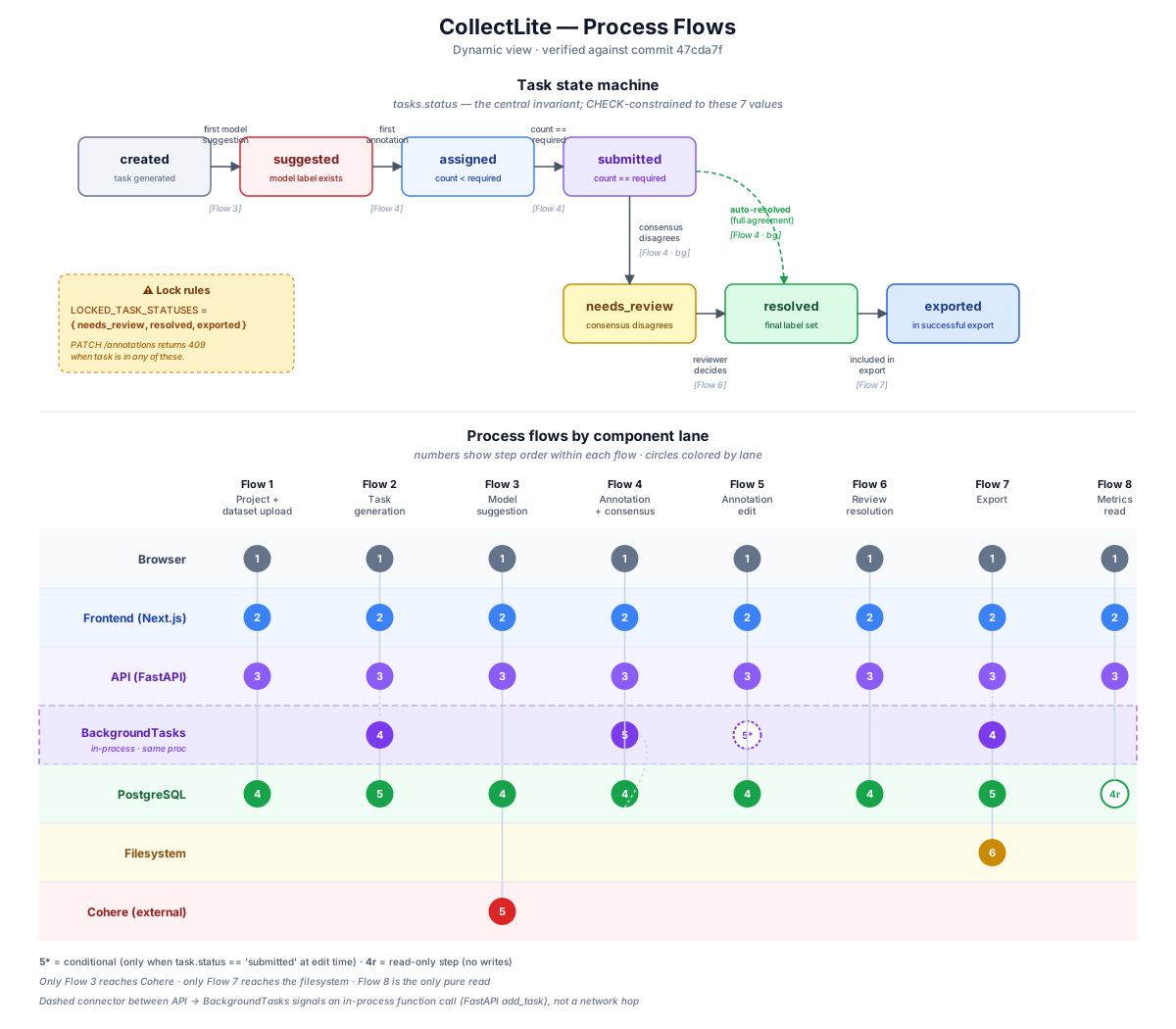
Flow 1 — Project creation
Purpose: initialize a workspace for a labeling/evaluation task.
User opens New Project page
  ↓
Frontend POSTs project payload to /api/projects
  ↓
Backend creates Project(status="draft")
  ↓
Backend provisions default task template if task_type == "rag_relevance"
  ↓
Project appears on dashboard and project overview page
Important implementation details:
- Projects are created in
draftstatus. ensure_default_templateseeds the default RAG relevance template.- If a task type has no known default template, project creation still succeeds, but no default template is created.
Design purpose:
- Keep the project object lightweight.
- Make the template explicit and versioned rather than hard-coded into every task.
- Allow future task types to add their own default schemas.
Flow 2 — Dataset upload and normalization
Purpose: convert a CSV/JSONL file into canonical source examples.
Project owner uploads CSV or JSONL
  ↓
Backend parses file
  ↓
Rows are normalized into pointwise examples
  ↓
Each example gets a deterministic source hash
  ↓
Duplicates inside the file are skipped
  ↓
Duplicates already present in the project are skipped
  ↓
Dataset row is created
  ↓
SourceExample rows are inserted
Supported input shapes:
Pointwise row
{
  "query": "What documents are needed for mortgage renewal?",
  "candidate_document": "You need income verification and property tax records.",
  "document_id": "doc_001",
  "metadata": "optional metadata"
}
Required fields:
query
candidate_document
If document_id is missing, the system creates one as row_{idx}.
Pairwise row
{
  "query": "What documents are needed for mortgage renewal?",
  "candidate_a": "Income verification and property tax records.",
  "candidate_b": "A branch address and appointment confirmation."
}
Required fields:
query
candidate_a
candidate_b
Pairwise rows are expanded into two pointwise examples:
row_0_a
row_0_b
This is a pragmatic design choice: the MVP evaluation loop is pointwise RAG relevance, but pairwise-shaped data can still enter the pipeline by being normalized into candidate-document examples.
Deduplication design:
source_hash = sha256(query + candidate_document + document_id)
The database also enforces uniqueness by project and source hash. This makes dataset upload idempotent at the source-example level.
Flow 3 — Task generation
Purpose: convert source examples into tasks that annotators can work on.
Project owner selects dataset + template
  ↓
Frontend POSTs /api/projects/{project_id}/tasks/generate
  ↓
Backend validates project, template, and dataset ownership
  ↓
Backend queues BackgroundTask generate_tasks
  ↓
Task generation service finds source examples without tasks for this template
  ↓
Task rows are inserted with status="created"
Key rule:
Do not create duplicate tasks for the same project/template/source example.
The service excludes examples that already have a task for the same project/template combination.
Current scope:
- The implemented route only supports
rag_relevanceprojects. - Required annotations default to
2, meaning consensus is not computed until two annotations exist.
Flow 4 — Model suggestion generation
Purpose: produce optional model-in-the-loop assistance before human annotation.
Annotator opens a task
  ↓
Annotator clicks "Generate model suggestion"
  ↓
Frontend POSTs /api/tasks/{task_id}/suggestion
  ↓
Backend loads task and source example payload
  ↓
Backend validates query + candidate_document
  ↓
If COHERE_API_KEY exists: call Cohere Rerank
Else: compute local lexical-overlap score
  ↓
Map score to relevance label
  ↓
Insert ModelSuggestion row
  ↓
If task was created, update task status to suggested
Suggestion output shape:
{
  "relevance": "relevant"
}
Plus metadata:
provider
model_name
confidence
raw_response
created_at
Design purpose:
- Preserve model output separately from human annotations.
- Allow model/human comparison later.
- Keep the demo usable without external API keys.
- Avoid treating model suggestions as authoritative labels.
Implementation caveat:
- Per-task suggestion generation is implemented.
- Bulk project-level suggestion generation is stubbed in the router/worker and not fully implemented.
- Cohere calls are synchronous in the request path. A production version should move these calls to a durable queue worker with retries and rate limiting.
Flow 5 — Annotation submission
Purpose: collect human labels and trigger consensus once enough labels exist.
Annotator opens task workbench
  ↓
Frontend loads task details, suggestions, and demo annotators
  ↓
Annotator selects relevance label + confidence
  ↓
Frontend POSTs /api/tasks/{task_id}/annotations
  ↓
Backend creates or reuses Assignment
  ↓
Backend writes Annotation
  ↓
Assignment becomes submitted
  ↓
Task becomes assigned or submitted depending on annotation count
  ↓
Backend queues consensus computation
Task status update rule after annotation:
if annotation_count >= required_annotations:
  task.status = "submitted"
else:
  task.status = "assigned"
Duplicate submission handling:
- If an annotator already submitted for a task, the backend returns
409with the existingannotation_idand points the client toward the PATCH endpoint. - The frontend uses this concept by switching to edit mode when the selected annotator already has an annotation.
Annotation edit rules:
- An annotation can be patched by the same annotator before the task is locked.
- Locked task statuses are:
needs_review
resolved
exported
Once a task reaches one of those states, edits return a conflict.
Flow 6 — Consensus computation
Purpose: transform multiple human annotations into a final or review-needed label.
Background consensus job runs
  ↓
Load task
  ↓
Load annotations
  ↓
If annotation count < required_annotations: stop
  ↓
Compute majority vote over label.relevance
  ↓
Compute human agreement score
  ↓
Load latest model suggestion
  ↓
Compare model suggestion to human majority label
  ↓
If humans disagree or model disagrees: task needs_review
Else: task resolved
  ↓
Create/update ConsensusResult
  ↓
Update task status
Current consensus method:
majority_vote over annotation.label.relevance
Agreement score:
agreement_score = majority_label_count / total_annotations
Review trigger logic:
requires_review = human_agreement < 1.0 OR model_suggestion_disagrees_with_majority
That means even a 2-vote split sends the task to review, and a unanimous human decision can still enter review if the latest model suggestion disagrees.
Design purpose:
- Consensus is deterministic and easy to explain.
- Raw annotations remain intact.
- Model-human disagreement becomes a first-class quality signal.
- Reviewer override is separated from raw annotation data.
Implementation caveat:
- The code comments correctly identify a potential future race: consensus rows are currently read then inserted/updated without a database-level unique constraint on
task_id. FastAPI background tasks are simple enough for the MVP, but a true concurrent worker setup should use a unique constraint plus an upsert.
Flow 7 — Review resolution
Purpose: adjudicate tasks that cannot be safely auto-resolved.
Reviewer opens project review queue
  ↓
Frontend GETs /api/projects/{project_id}/review/tasks
  ↓
Backend returns tasks with source payload, annotations, model suggestion, consensus
  ↓
Reviewer selects final label and optional reason
  ↓
Frontend POSTs /api/tasks/{task_id}/review
  ↓
Backend validates task is needs_review
  ↓
Backend writes ReviewDecision
  ↓
Backend updates latest ConsensusResult to review_resolved
  ↓
Backend sets task.status = resolved
  ↓
Backend writes audit event
If no reviewer ID is supplied, the backend creates or reuses a system reviewer:
system-reviewer@collectlite.local
Design purpose:
- Keep reviewer decisions auditable.
- Preserve original annotator labels and notes.
- Use review decisions to produce the final export label.
- Avoid silently overwriting disagreement with an auto-resolution.
Flow 8 — Metrics read
Purpose: give project owners visibility into progress and quality.
Frontend GETs /api/projects/{project_id}/metrics
  ↓
Backend counts tasks by status
  ↓
Backend loads latest consensus rows
  ↓
Backend computes average human agreement
  ↓
Backend computes label distribution
  ↓
Backend compares latest model suggestion to consensus label
  ↓
Backend returns metrics payload
Returned metric categories:
| Metric | Meaning |
|---|---|
total_tasks |
Total tasks in the project |
| status counts | Count by lifecycle state |
avg_human_agreement |
Mean consensus agreement score across tasks with consensus |
model_human_agreement_rate |
Share of tasks where latest model suggestion matched human consensus |
final_label_distribution |
Counts of final labels |
exportable_task_count |
Number of resolved tasks ready for export |
Design purpose:
- Make progress visible without manual database inspection.
- Surface review backlog and label distribution.
- Turn model-human disagreement into a measurable quality signal.
Implementation note:
- Metrics are computed on read rather than materialized into a separate table.
- This is fine for demo scale, but larger projects would benefit from cached aggregates or materialized views.
Flow 9 — Export generation
Purpose: produce a clean dataset for downstream model evaluation/training.
Project owner clicks JSONL or CSV export
  ↓
Frontend POSTs /api/projects/{project_id}/exports
  ↓
Backend creates Export(status="queued")
  ↓
Backend queues create_export BackgroundTask
  ↓
Export job loads resolved tasks only
  ↓
For each task, collect source payload, latest consensus, latest model suggestion, review flag
  ↓
Serialize rows to JSONL or CSV
  ↓
Write file to exports directory
  ↓
Mark included tasks as exported
  ↓
Export status becomes completed
  ↓
Frontend polling exposes download link
Export row contract:
{
  "query": "...",
  "candidate_document": "...",
  "document_id": "...",
  "final_label": "relevant",
  "label_source": "consensus",
  "model_suggestion": "partially_relevant",
  "model_score": 0.53,
  "human_agreement": 1.0,
  "metadata": {}
}
label_source is either:
consensus
review
Design purpose:
- Export only resolved tasks.
- Include enough provenance for evaluation analysis.
- Preserve model suggestion metadata for model-vs-human comparison.
- Move exported tasks to
exportedto prevent accidental duplicate export semantics.
Implementation caveat:
- Export files are local filesystem artifacts.
- There is no export version diffing yet.
- There is no object storage or signed URL layer yet.
6. Task State Machine
The task state machine is the backbone of CollectLite.
created
  ↓ model suggestion generated
suggested
  ↓ first annotation submitted, but not enough annotations yet
assigned
  ↓ required annotation count reached
submitted
  ↓ consensus job runs
needs_review OR resolved
  ↓ reviewer decision if needed
resolved
  ↓ export job includes task
exported
State meanings
| State | Meaning | Producer |
|---|---|---|
created |
Task exists but has no model suggestion or annotation yet | Task generation job |
suggested |
At least one model suggestion exists | Model suggestion service |
assigned |
Task has started receiving annotations, but not enough for consensus | Annotation submission route |
submitted |
Required annotation count reached; consensus can run | Annotation submission route |
needs_review |
Consensus found human disagreement or model-human disagreement | Consensus service |
resolved |
Final label is ready for export | Consensus service or review service |
exported |
Task was included in an export | Export job |
Locking rule
Annotations become locked at:
needs_review
resolved
exported
Why this matters:
- Reviewers need stable evidence during adjudication.
- Resolved labels should not change underneath an export.
- Exported tasks should represent a frozen dataset snapshot.
Important edge cases
| Edge case | Current handling |
|---|---|
| Annotator submits twice | Backend returns 409 and identifies the existing annotation |
| Annotator edits after task is locked | Backend returns 409 |
| Task has too few annotations | Consensus job returns without changing state |
| Model suggestion missing | Consensus can still resolve based on human agreement |
| Model suggestion disagrees with human majority | Task enters review |
| Export job fails midway | Transaction rolls back; partial file is removed if possible; export status becomes failed |
7. API Surface
Projects
| Method | Endpoint | Purpose |
|---|---|---|
POST |
/api/projects |
Create project and default template if available |
GET |
/api/projects |
List projects |
GET |
/api/projects/{project_id} |
Get one project |
PATCH |
/api/projects/{project_id} |
Update project fields |
Datasets
| Method | Endpoint | Purpose |
|---|---|---|
POST |
/api/projects/{project_id}/datasets |
Upload and normalize CSV/JSONL |
GET |
/api/projects/{project_id}/datasets |
List datasets for project |
GET |
/api/datasets/{dataset_id}/errors |
Intended validation-error endpoint; currently not implemented |
Templates and tasks
| Method | Endpoint | Purpose |
|---|---|---|
GET |
/api/projects/{project_id}/templates |
List task templates |
GET |
/api/projects/{project_id}/tasks |
List project tasks, optional status filter |
POST |
/api/projects/{project_id}/tasks/generate |
Queue task generation |
POST |
/api/projects/{project_id}/tasks/suggest |
Intended bulk suggestion endpoint; currently not implemented |
GET |
/api/tasks/next |
Select next available task |
GET |
/api/tasks/{task_id} |
Get task detail with source example, suggestion, annotations |
Suggestions
| Method | Endpoint | Purpose |
|---|---|---|
POST |
/api/tasks/{task_id}/suggestion |
Generate one model suggestion immediately |
GET |
/api/tasks/{task_id}/suggestions |
List suggestions for a task |
POST |
/api/tasks/{task_id}/suggestions |
Intended request endpoint; currently not implemented |
Annotations
| Method | Endpoint | Purpose |
|---|---|---|
POST |
/api/tasks/{task_id}/annotations |
Submit annotation |
PATCH |
/api/tasks/{task_id}/annotations/{annotation_id} |
Edit existing annotation before lock |
POST |
/api/tasks/{task_id}/skip |
Intended skip endpoint; currently not implemented |
Consensus and review
| Method | Endpoint | Purpose |
|---|---|---|
POST |
/api/tasks/{task_id}/consensus |
Intended manual consensus trigger; currently not implemented |
GET |
/api/tasks/{task_id}/consensus |
Intended consensus read endpoint; currently not implemented |
GET |
/api/projects/{project_id}/review/tasks |
List tasks needing review |
POST |
/api/tasks/{task_id}/review |
Submit reviewer decision |
Metrics
| Method | Endpoint | Purpose |
|---|---|---|
GET |
/api/projects/{project_id}/metrics |
Compute project metrics |
Exports
| Method | Endpoint | Purpose |
|---|---|---|
POST |
/api/projects/{project_id}/exports |
Queue export |
GET |
/api/projects/{project_id}/exports |
List project exports |
GET |
/api/exports/{export_id} |
Get export metadata |
GET |
/api/exports/{export_id}/download |
Download completed export file |
Users
| Method | Endpoint | Purpose |
|---|---|---|
GET |
/api/annotators |
Ensure and list demo annotators |
8. Why Each Major Component Exists
Project dashboard
Purpose: give project owners a home base for annotation operations.
It answers:
- How many projects exist?
- Which are active or draft?
- Which project should I open next?
Dataset uploader
Purpose: convert messy raw data into normalized, deduplicated examples.
It prevents:
- Duplicate rows from becoming duplicate labels.
- Invalid rows from entering the task queue.
- Downstream tasks from depending on arbitrary CSV/JSONL schemas.
Task template system
Purpose: make annotation instructions and label schema explicit.
It supports:
- Stable instruction versions.
- Reusable project-level task definitions.
- Future expansion to other task types.
Task generator
Purpose: create the actual unit of work from source examples.
It enforces:
- One task per example/template pair.
- Required annotation counts.
- A clear initial
createdstate.
Model suggestion service
Purpose: accelerate annotation and create a comparison baseline.
It enables:
- Model-in-the-loop pre-labeling.
- Human-vs-model agreement metrics.
- Fast local demos without external calls.
Annotator workbench
Purpose: make labeling fast and clear.
It provides:
- Source query and candidate document.
- Model suggestion panel.
- Label and confidence controls.
- Annotator identity switcher for demo flows.
- Submit, edit, next-task, and skip navigation.
Consensus engine
Purpose: convert raw labels into a final label or review request.
It protects quality by:
- Waiting for enough annotations.
- Requiring full agreement for auto-resolution.
- Routing human disagreement to review.
- Routing model-human disagreement to review.
Review queue
Purpose: let a reviewer adjudicate uncertain tasks.
It centralizes:
- All human annotations.
- Latest model suggestion.
- Consensus status.
- Source payload and metadata.
- Final reviewer decision.
Metrics dashboard
Purpose: expose workflow health and data quality.
It answers:
- How many tasks exist in each state?
- How many tasks are ready to export?
- Are annotators agreeing?
- Is the model agreeing with humans?
- What is the label distribution?
Export pipeline
Purpose: produce downstream-ready datasets.
It guarantees:
- Only resolved tasks are exported.
- Each row includes final label and provenance fields.
- JSONL and CSV are both supported.
- Export records are queryable and downloadable.
9. Reliability and Correctness Design
Idempotency
CollectLite includes several idempotency-oriented choices:
| Area | Mechanism |
|---|---|
| Source examples | Deterministic source hash and project-level uniqueness |
| Upload processing | Dedupes within a file and against existing project examples |
| Task generation | Excludes source examples that already have tasks for the same template |
| Assignment | Reuses an existing assignment for the same task/annotator |
| Export failure cleanup | Removes partial export files when possible |
State constraints
The database constrains enum-like fields using SQL check constraints. This helps prevent accidental invalid lifecycle states.
Examples:
- Project status is constrained to
draft,active,paused,completed. - Task status is constrained to the seven task states.
- Assignment status is constrained to
assigned,submitted,skipped,expired. - Export format is constrained to
jsonlorcsv. - Export status is constrained to
queued,running,completed, orfailed.
Error handling
The backend maps common workflow errors to appropriate HTTP responses:
| Situation | Response style |
|---|---|
| Project/task/template/dataset not found | 404 |
| Template does not belong to project | 400 |
| Unsupported upload type | 400 |
| Invalid row schema | 400 with row-level error details |
| Annotating terminal task | 409 |
| Editing locked task | 409 |
| Missing model input fields | 422 |
| Export not completed | 409 |
| Export file missing | 410 |
Observability
Current observability features:
/healthendpoint.- Per-request latency header.
- Export failure logging.
- Audit event model and review-decision audit logging.
- Metrics endpoint for workflow and quality monitoring.
Recommended next observability upgrades:
- Structured JSON logs for every state transition.
- Correlation IDs for upload/task/export jobs.
- OpenTelemetry traces across API, background jobs, database, and model provider calls.
- Prometheus metrics for queue depth, model latency, export failures, and consensus outcomes.
- Audit events for all critical mutations, not just review resolution.
10. Security and Access Control
Current state
The data model includes users and roles, and the frontend includes next-auth as a dependency. However, the current backend routes do not enforce full authentication or role-based authorization.
Current role model:
admin
owner
annotator
reviewer
Current demo behavior:
- The
/api/annotatorsendpoint auto-creates two demo annotator users: Alice and Bob. - The task workbench lets the user select which annotator they are acting as.
This is useful for demoing multi-annotator consensus without requiring a full auth stack.
Production-grade additions
For a production version, I would add:
- Authentication with signed sessions/JWTs.
- Route-level role checks.
- Project-level membership and permissions.
- Organization-level tenancy.
- PII detection/redaction for uploaded examples.
- Export access controls and signed download URLs.
- Secret management for provider keys.
- Rate limiting on upload and model-suggestion routes.
11. Scalability Analysis
Current demo scale
The current design is appropriate for:
- A handful of projects.
- Thousands of source examples.
- Tens of thousands of generated tasks.
- Small annotator pools.
- Synchronous local demos.
- Interview walkthroughs and portfolio demonstration.
Bottlenecks
| Bottleneck | Why it matters | Upgrade path |
|---|---|---|
| In-process background tasks | Jobs share lifecycle with API process | Move to Redis Queue, Celery, Dramatiq, or Sidekiq-style worker |
| Synchronous Cohere call | Request thread waits on external model provider | Queue model suggestions, add retries/rate limits, persist job state |
| Metrics computed on read | Can become expensive for large projects | Materialized metrics table or cached aggregates |
| Local filesystem exports | Not durable across container restarts/deploys | Object storage with signed URLs |
| No row-level project auth | Multi-project security risk in production | Project memberships and role middleware |
| Consensus race risk | Concurrent jobs can duplicate consensus rows | Unique constraint on consensus_results.task_id plus upsert |
| No task claiming lock | Multiple annotators could receive same task under concurrency | Row-level locking / lease-based assignments |
Production-ready evolution
A more scalable version would look like:
Browser
  ↓
Next.js frontend
  ↓
API gateway / FastAPI backend
  ↓
PostgreSQL
  ↓
Redis / durable job queue
  ↓
Worker pool
  ├─ ingestion workers
  ├─ model suggestion workers
  ├─ consensus workers
  ├─ export workers
  └─ metrics aggregation workers
  ↓
Object storage for exports
  ↓
Observability stack
12. Testing Strategy
A strong testing strategy for this repo should mirror the lifecycle.
Backend unit tests
Priority tests:
parse_uploadsupports JSONL and CSV.normalize_rowshandles pointwise rows.normalize_rowsexpands pairwise rows.- Upload rejects missing required fields.
- Source hashing is deterministic.
- Duplicate source examples are skipped.
- Task generation is idempotent.
- Model suggestion fallback maps lexical scores to labels.
- Consensus waits for required annotation count.
- Consensus auto-resolves full agreement.
- Consensus sends human disagreement to review.
- Consensus sends model-human disagreement to review.
- Review decisions update consensus and task status.
- Export includes only resolved tasks.
- Export marks included tasks as exported.
Frontend tests
Priority tests:
- Dashboard handles empty projects.
- Dataset page displays upload success and dataset rows.
- Tasks page disables generation until dataset/template selected.
- Task workbench switches from create mode to edit mode for existing annotation.
- Locked tasks prevent annotation edits.
- Review page submits final decision and refreshes queue.
- Metrics page renders workflow funnel.
- Exports page polls pending exports and shows download link when complete.
End-to-end demo test
Best E2E scenario:
Create project
  ↓
Upload sample JSONL
  ↓
Generate tasks
  ↓
Generate a model suggestion for a task
  ↓
Submit two matching annotations
  ↓
Verify task resolves automatically
  ↓
Submit disagreement on another task
  ↓
Verify task enters review
  ↓
Submit reviewer decision
  ↓
Create JSONL export
  ↓
Download export and validate schema
13. Implementation Status Matrix
| Capability | Status | Notes |
|---|---|---|
| Project CRUD | Implemented | Creates default RAG relevance template |
| Dataset upload | Implemented | CSV/JSONL parsing, normalization, dedupe |
| Source example persistence | Implemented | JSONB payload and source hash |
| Task template list | Implemented | Default template for rag_relevance |
| Task generation | Implemented | BackgroundTask, idempotent per template/example |
| Task listing/detail | Implemented | Includes source payload, annotations, latest suggestion summary |
| Next task selection | Implemented in router | Service-level helper remains stubbed |
| Per-task model suggestion | Implemented | Cohere or local fallback |
| Bulk project suggestions | Not implemented | Endpoint and worker shape exist |
| Annotation submission | Implemented | Assignment creation, duplicate protection, consensus background task |
| Annotation editing | Implemented | Locked after review/resolution/export |
| Skip task | Not implemented | UI calls endpoint, backend stub exists |
| Consensus computation | Implemented as service/job | API endpoints for manual consensus are stubs |
| Review queue | Implemented | Lists evidence and accepts decisions |
| Metrics endpoint/UI | Implemented | Computed on read |
| JSONL/CSV export | Implemented | Local filesystem output |
| Audit log | Partially implemented | Review decisions logged; other mutations not yet logged |
| Auth/RBAC | Partially modeled | Roles exist, enforcement not implemented |
| Redis queue | Not used | Redis service exists in Docker Compose |
| Durable export storage | Not implemented | Local filesystem only |
14. Demo Script
The most convincing demo is a RAG relevance-evaluation workflow.
Setup
cp .env.example .env
# Optional: add COHERE_API_KEY for real Cohere Rerank suggestions
docker compose up --build
Optional seed path:
docker compose exec backend python -m scripts.seed
Walkthrough
- Open the frontend at
http://localhost:3000. - Create a project named
RAG Relevance Evaluationwith task typerag_relevance. - Open the Datasets tab and upload a JSONL/CSV file with
queryandcandidate_documentcolumns. - Open the Tasks tab, select the uploaded dataset and default template, then generate tasks.
- Open a task detail page.
- Generate a model suggestion.
- Submit an annotation as Alice.
- Submit another annotation as Bob.
- If they agree and the model agrees, show auto-resolution.
- If they disagree, open the Review page and resolve the task.
- Open Metrics to show status funnel, human agreement, model-human agreement, and label distribution.
- Open Exports and generate JSONL or CSV.
- Download the export and inspect final labels/provenance.
What to emphasize while demoing
- The system separates raw examples, tasks, annotations, suggestions, consensus, review, and export records.
- Model suggestions are optional and auditable.
- The final label is not just a raw annotation; it is the result of consensus or reviewer adjudication.
- Export output includes provenance fields useful for model evaluation.
- The project is intentionally production-shaped even though the runtime is demo-scale.
15. Interview / Portfolio Talking Points
One-sentence summary
CollectLite is a full-stack human-data platform that turns raw RAG examples into reviewed, model-evaluation-ready labels through dataset ingestion, model-in-the-loop suggestions, annotator workflows, consensus, review, metrics, and JSONL/CSV export.
Strong technical points
- End-to-end ownership — frontend, backend, database schema, workflow state machine, and local infrastructure are all represented.
- Human-data domain fit — the system models real problems in annotation quality: disagreement, reviewer override, model bias, provenance, and export correctness.
- Data modeling discipline — annotations, model suggestions, consensus results, review decisions, and exports are separate entities.
- Model-in-the-loop thinking — model output is useful, but not trusted as ground truth.
- Production-shaped architecture — migrations, typed schemas, background jobs, check constraints, audit events, and metrics are present.
- Clear MVP scoping — the repo focuses on RAG relevance labeling instead of trying to implement every annotation mode at once.
Honest limitations to mention
- Bulk model suggestions are planned but not implemented.
- Redis is included but not yet used as a job broker.
- Auth/RBAC is modeled but not enforced.
- Export storage is local filesystem, not durable object storage.
- Task claiming needs row-level locking or lease semantics for high concurrency.
- Some API shape endpoints are stubs (
skip, manual consensus, dataset errors, bulk suggestions).
These limitations are not fatal; they are useful because they show you understand the difference between a demo-scale system and a production-scale human-data platform.
16. Future Improvements
Product improvements
- Add keyboard-first annotation shortcuts.
- Add blind annotation mode so some tasks hide model suggestions.
- Add gold-task injection and annotator reliability dashboards.
- Add project-level reviewer notes and escalation reasons.
- Add dataset preview and row-level validation UI.
- Add export schema preview before creating an export.
- Add export version comparison.
Backend improvements
- Replace in-process BackgroundTasks with a durable queue.
- Implement bulk model-suggestion jobs.
- Implement skip behavior with skip counts and requeue policy.
- Implement manual consensus read/trigger endpoints.
- Add unique constraint/upsert for consensus rows.
- Add row-level task claiming with
SELECT ... FOR UPDATE SKIP LOCKED. - Add object storage for export files.
- Add full audit logging for upload, task generation, annotation, consensus, review, and export.
Frontend improvements
- Add generated API types from FastAPI OpenAPI.
- Add stronger form validation and upload previews.
- Add charts with Recharts for throughput and label distribution.
- Add loading skeletons and optimistic updates.
- Add reviewer comparison view with side-by-side annotation cards.
- Add project settings for required annotations, review thresholds, and model-suggestion visibility.
Security improvements
- Add authentication.
- Enforce role-based access control.
- Add project membership and organization tenancy.
- Redact or classify sensitive data before showing examples to annotators.
- Move secrets to a proper secret manager.
- Add signed export URLs.
System design improvements
- Add event-driven lifecycle transitions.
- Add metrics materialization.
- Add OpenTelemetry tracing.
- Add Prometheus/Grafana dashboarding.
- Add retry policy and dead-letter queue for model calls.
- Add cost tracking for model suggestions.
- Add multi-provider model suggestion abstraction.
17. Final Architecture Summary
CollectLite is best understood as a compact but credible human-data platform with a clear separation of concerns:
Frontend
  Owns user workflow and presentation.

FastAPI routers
  Own HTTP contracts and request validation.

Services
  Own domain behavior: ingestion, task generation, suggestions, consensus, review, metrics, export.

SQLAlchemy models
  Own persistent entities and lifecycle constraints.

BackgroundTasks
  Own asynchronous-ish long-running work in the MVP.

PostgreSQL
  Owns durable state and provenance.

Cohere/local fallback
  Provides optional model-in-the-loop suggestions.

Filesystem exports
  Provide downloadable evaluation/training artifacts.
The project demonstrates the most important systems idea behind annotation platforms: the labeling UI is only one piece. A reliable human-data system also needs lifecycle state, data normalization, assignment rules, model-assistance provenance, consensus logic, reviewer adjudication, metrics, auditability, and controlled exports.